Game of Thrones

Compositeur non renseigné

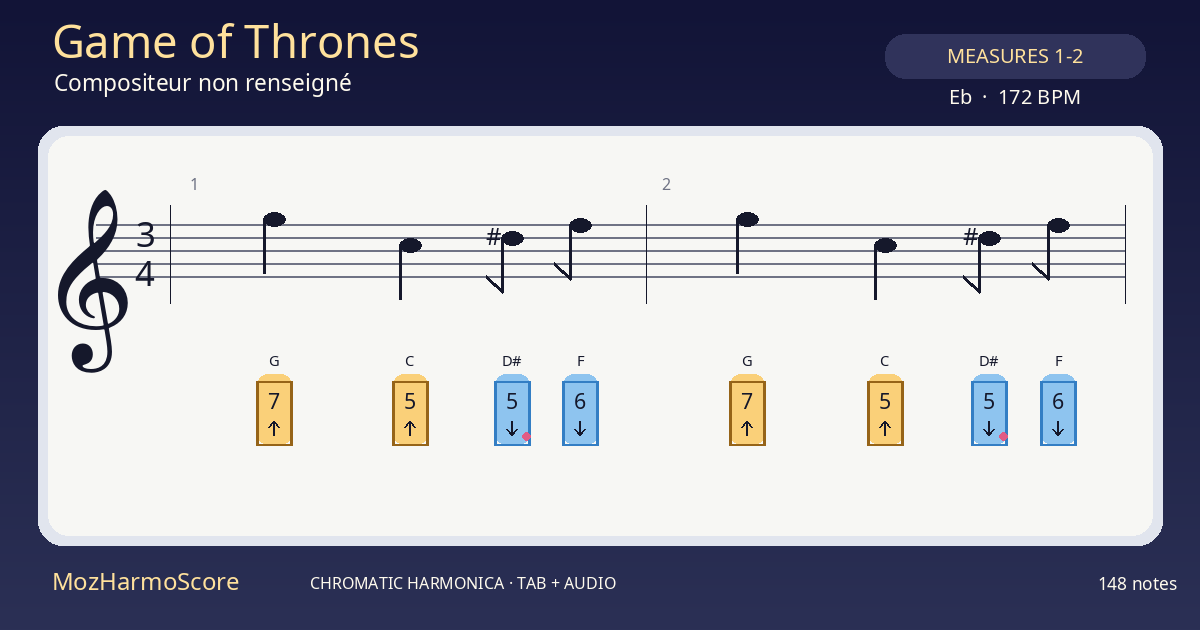
Play Game of Thrones on chromatic harmonica with synchronized tab, audio, key Eb and 172 BPM tempo. Slow it down and practise for free.

Movies & TVIntermediate148 notesEb172 BPM
MozHarmoScore

About this score

This score offers an instrumental study inspired by the Game of Thrones universe, focusing on a dark and solemn tone in the key of Eb. The recurring melodic cells require steady articulation. At an intermediate level, the challenge is to maintain calm expression despite the brisk tempo and wide register. Begin by mastering repeated motifs, then connect them while keeping a stable pulse and gradually building dynamics.

Presentation

This version of Game of Thrones is designed for intermediate chromatic harmonica players aiming to strengthen control over register shifts and altered notes. The score features an immediately recognizable motif, sustained long notes, and movements covering a wide range. The final tempo is energetic, but the main difficulty lies in sound control: each repetition must remain stable, connected, and expressive. Approach the piece in short sections with a slow metronome, gradually increasing speed without sacrificing transition accuracy.

Why learn this piece

This theme develops rhythmic regularity and breath continuity within a wide register. It also helps integrate altered notes naturally into a connected melody at an intermediate level, avoiding treating them as isolated accidentals.

Skills developed

Legato★★★★☆
Swing★★☆☆☆
Chromatic button★★★☆☆
Rhythm★★★☆☆
Speed★★★★☆
Expression★★★★☆

Music DNA

Jazz feeling35%
Expression63%
Technique100%
Breath100%
Reading64%
Improvisation35%
Rhythm45%
Chromatic button72%

AI musical analysis

Written in Eb, the piece spans a wide range from G#4 to C7. Repeated motifs structure the listening experience, while half notes and numerous ties demand a sustained line. Altered notes are frequent and must fit naturally into the phrasing. Large intervals reaching an octave or more require auditory and physical preparation before each register change.

Technical data

Notes148
Measures67
Tempo172 BPM
KeyEb
Lowest noteG#4
Highest noteC7
Max intervaloctave or more
Dominant rhythmhalf notes
Altered notes28%
Avg. breath5.7 notes
Fast rhythms0
Rests0
Repeated notes31
Ties46
Rangewide

Progression plan

Day 1120 BPM

Slow reading of the first two lines.

Day 2130 BPM

Stabilize breath and ties.

Goal172 BPM

Play cleanly at target tempo.

Musical goals

  • Maintain a homogeneous legato through ties.
  • Precisely place altered notes within a continuous phrase.
  • Manage transitions between low, middle, and high registers.
  • Keep pulse steady within repeated motifs.

Common mistakes

  • Forcing breath in the high register instead of preparing register changes.
  • Pressing the chromatic button too long and distorting the following note.
  • Shortening half notes and ties due to insufficient breath support.
  • Speeding up at each repetition of the main motif.

Coach tips

  • Mentally sing the interval before large jumps, then play it without sliding.
  • Record a four-measure loop to check repetition consistency.
  • Add dynamics only when rhythm and transitions are reliable.

If you liked this piece

Tab analysis and practice

AI summary

Intermediate study of a theme with a wide range, based on repeated motifs, ties, and many altered notes.

Suggested tempo80 -> 172 BPM

Practice goals

  • Stabilize recurring motifs before playing all 67 measures continuously.
  • Secure altered notes in Eb without breaking the legato.

Passages to isolate

  • The G–C cells followed by altered notes: isolate them in slow loops.
  • Large leaps to the high register, especially during register changes.

Focus points

  • Prepare long ties with a steady airflow rather than attacking each note.
  • Keep the half notes exactly on the beat, even when motifs repeat.

Coach

  • Distribute air evenly over long notes and anticipate register changes without tightening the throat.
  • Work altered notes separately with brief, precise button presses, then reintegrate them into the motif.
  • Count half notes quietly and avoid speeding up the two eighth-note transitions.
  • Do not confuse motif repetition with mechanical repetition: maintain the same pulse but evolve the dynamics.