Hallelujah

Leonard Cohen

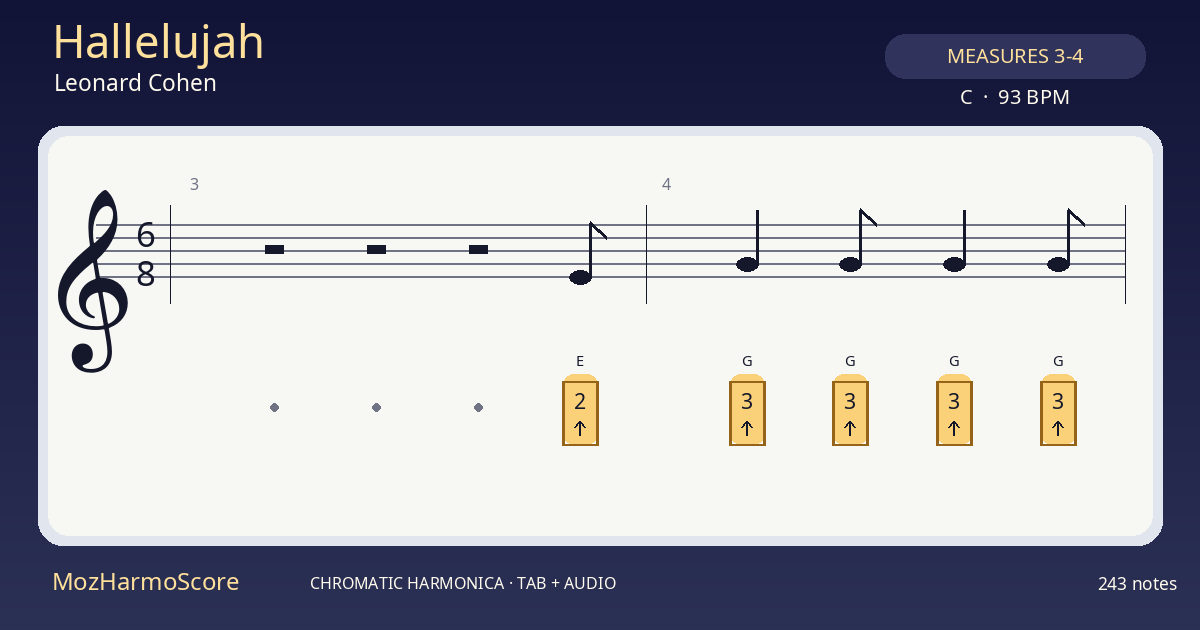
Free Hallelujah harmonica notes and tab for chromatic harmonica, synchronized with audio. Key C, 93 BPM — slow it down and practise.

Pop / varietyEasy243 notesC93 BPM
MozHarmoScore

About this score

This piece works well as a calm, step-by-step study for chromatic harmonica players. It invites careful listening, steady breathing, and patient phrasing rather than speed.

Presentation

This mini-course guides you through Hallelujah on chromatic harmonica. The score is analysed in C at 93 BPM to develop steady reading, clean attacks and organized breathing. Start slowly, isolate register changes, then reconnect the phrases without forcing the tone.

Why learn this piece

It is a useful piece for turning note reading into musical control: breath, rhythm, and consistency at 93 BPM.

Skills developed

Legato★★★★☆
Swing★★☆☆☆
Chromatic button★☆☆☆☆
Rhythm★★★☆☆
Speed★★☆☆☆
Expression★★★★☆

Music DNA

Jazz feeling35%
Expression70%
Technique45%
Breath100%
Reading80%
Improvisation35%
Rhythm80%
Chromatic button0%

AI musical analysis

A progressive plan to stabilize timing, breath and attacks in Hallelujah at 93 BPM.

Technical data

Notes243
Measures79
Tempo93 BPM
KeyC
Lowest noteC4
Highest noteE6
Max intervaloctave or more
Dominant rhythmquarter notes
Altered notes0%
Avg. breath8.1 notes
Fast rhythms0
Rests35
Repeated notes116
Ties18
Rangewide

Progression plan

Day 170 BPM

Read the first two lines slowly and keep the airflow steady.

Day 280 BPM

Stabilize breathing and note connections at a moderate tempo.

Goal93 BPM

Play cleanly at the target tempo of 93 BPM.

Musical goals

  • Reading in the key of C
  • Breath control and clean attacks

Common mistakes

  • Rushing the tempo before two slow runs are clean.

Coach tips

  • Begin at 70 BPM, then add 5 BPM only when the sound remains stable.

If you liked this piece

Tab analysis and practice

AI summary

A progressive plan to stabilize timing, breath and attacks in Hallelujah at 93 BPM.

Suggested tempo70 -> 93 BPM

Practice goals

  • Play one full line without breaking the airflow, even at a slow tempo.
  • Increase the tempo by 5 BPM only after two clean runs in a row.

Passages to isolate

  • Isolate the least natural note changes and repeat them away from tempo before reconnecting them to the line.
  • Use the rests as planned breathing points, not as uncertain pauses.

Focus points

  • On repeated notes, keep the attack light so the sound stays warm and natural.

Coach

  • Use continuous breath, short attacks, and planned breathing points.
  • Practice with a metronome in 5 BPM steps.
  • Do not raise the tempo before two clean slow readings.