Le Train qui ne Revient Pas
Composition originale — MozartMatch
Free Le Train qui ne Revient Pas harmonica notes and tab for chromatic harmonica, synchronized with audio. Key G, 92 BPM — slow it down and practise.
ClassicalBeginner75 notesG92 BPM
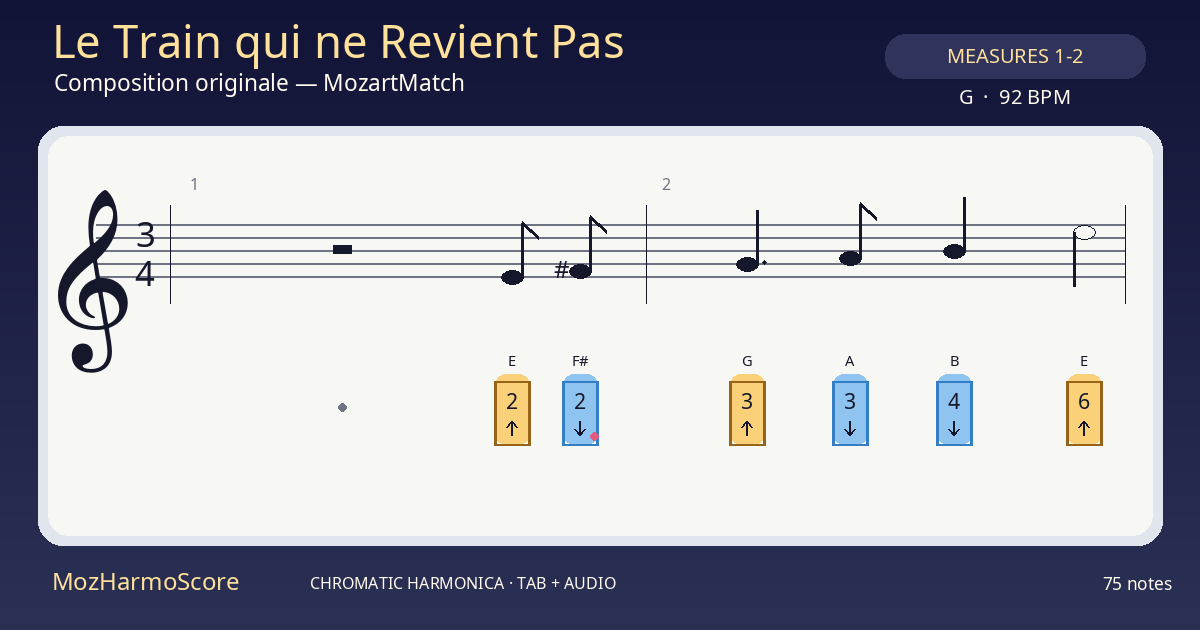
Free Le Train qui ne Revient Pas harmonica notes and tab for chromatic harmonica, synchronized with audio. Key G, 92 BPM — slow it down and practise.
This sheet offers a step-by-step approach to mastering the piece on chromatic harmonica: listen carefully, slow down the tempo, isolate challenging passages, and rebuild your interpretation progressively.
Le Train qui ne Revient Pas is presented here as a focused practice resource for chromatic harmonica players. This page combines tablature, audio, technical data, and a clear progression method. The goal is not only to play the notes but to organize breath, maintain steady tempo, and prepare for delicate passages with confidence.
This piece helps transform note reading into concrete musical gestures by emphasizing breath control, rhythm, and consistency at 92 BPM.
The score contains 79 notes over approximately 28 measures, dominated by quarter notes. About 13% of the notes are altered, requiring chromatic button use. The largest interval is a fourth. Focus first on smooth transitions, then isolate breathing points and repeated notes.
Slow reading of the first two lines.
Stabilize breath and legato connections.
Play cleanly at target tempo of 92 BPM.
Start practicing Le Train qui ne Revient Pas at 69 BPM, then gradually increase to 92 BPM once clean attacks are consistent. The key of G encourages simple finger movements and steady breath control.