Sous la Table

Composition originale — MozartMatch

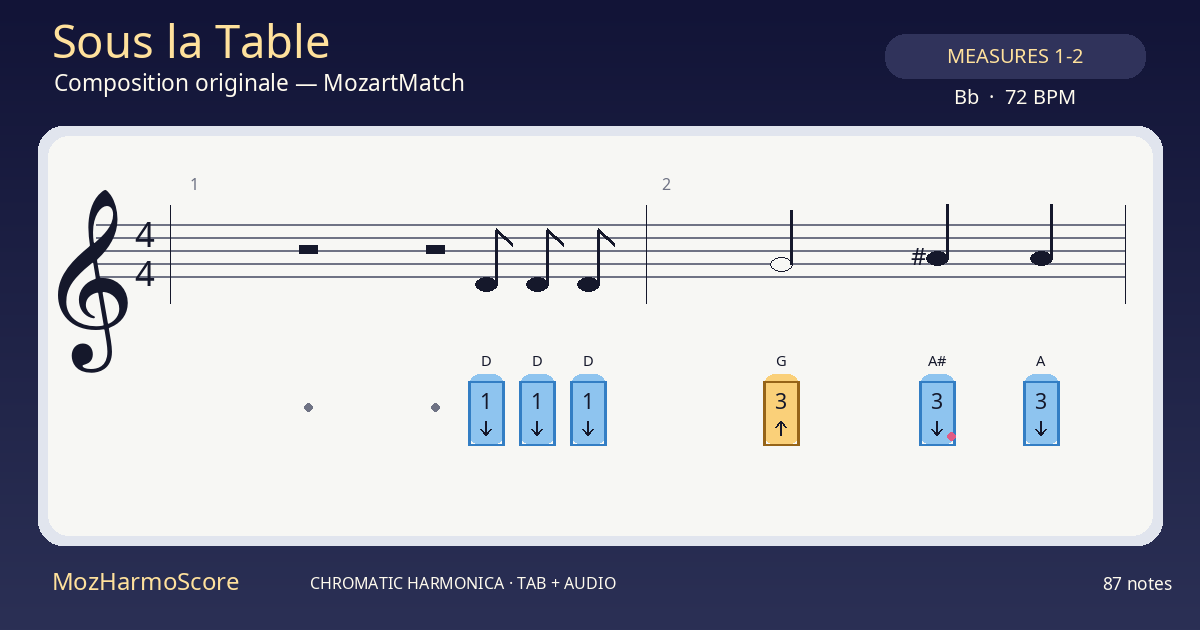
Free Sous la Table harmonica notes and tab for chromatic harmonica, synchronized with audio. Key Bb, 72 BPM — slow it down and practise.

ClassicalIntermediate87 notesBb72 BPM
MozHarmoScore

About this score

Sous la Table is an original composition by MozartMatch designed as an expressive exercise for chromatic harmonica players. Its moderate tempo allows you to focus on phrase continuity, while the wide range and numerous altered notes require careful preparation. Approach it as a musical study: sing each line before playing, identify register changes, and shape sustained notes with intention. The goal is not speed but a calm, stable, and nuanced melodic line.

Presentation

Sous la Table is an intermediate-level piece for chromatic harmonica focusing on melodic line quality rather than speed. At 72 BPM in B-flat major, it alternates repeated notes, sustained values, legato, and movements into the high register. The range from low D to high Bb demands good instrument mapping and stable embouchure. Altered notes add expressive color when prepared smoothly. Work in short segments, sing challenging intervals, and aim for a seamless sound between phrases.

Skills developed

Legato★★★★☆
Swing★★☆☆☆
Chromatic button★★★☆☆
Rhythm★★★☆☆
Speed★★☆☆☆
Expression★★★★☆

Music DNA

Jazz feeling35%
Expression60%
Technique95%
Breath85%
Reading56%
Improvisation35%
Rhythm48%
Chromatic button72%

AI musical analysis

Set in B-flat major, the piece has a classical, poised character driven mainly by quarter notes and some dotted rhythms. The 25 altered notes require reliable chromatic button coordination. Legato and sustained notes encourage a continuous melodic line rather than marked attacks. Intervals up to an octave or more demand auditory and spatial anticipation.

Technical data

Notes87
Measures24
Tempo72 BPM
KeyBb
Lowest noteD4
Highest noteA#5
Max intervaloctave or more
Dominant rhythmquarter notes
Altered notes29%
Avg. breath7.3 notes
Fast rhythms0
Rests3
Repeated notes15
Ties16
Rangewide

Progression plan

Day 150 BPM

Slow reading of the first two lines.

Day 260 BPM

Stabilize breath control and legato connections.

Goal72 BPM

Play cleanly at target tempo of 72 BPM.

Musical goals

  • Link altered notes accurately.
  • Manage a wide range without tension.
  • Maintain legato on ties and long notes.
  • Control pulse at a moderate tempo.

Common mistakes

  • Attacking tied notes too strongly and breaking the phrase.
  • Engaging the chromatic button too late on altered notes.
  • Speeding up after jumps to the high register.
  • Running out of breath on long notes due to poor anticipation.

Coach tips

  • Sing the target note of each large jump before playing it.
  • Practice altered notes alone, then add one note before and after.
  • Imagine a single air column on legato passages rather than multiple attacks.
  • Record yourself at slow tempo to monitor tuning in the high register.

If you liked this piece

Tab analysis and practice

AI summary

At 72 BPM, the main challenge is maintaining smooth legato across a wide range with 25 altered notes and several large jumps. Begin by securing accurate chromatic changes, then connect phrases without weighing down repeated notes.

Suggested tempo60 -> 72 BPM

Practice goals

  • Stabilize transitions between low, middle, and high registers.
  • Produce altered notes with clean, precise attacks.
  • Maintain breath flow through legato without unintended accents.
  • Keep a steady pulse of quarter notes at 72 BPM.

Passages to isolate

  • Ascending lines into the high register after sustained notes.
  • Sequences involving D#, F#, and Bb altered notes.
  • Large interval jumps, especially octave or more.
  • Repeated notes in the low register followed by long sustained values.

Focus points

  • Prepare breath changes before long legato connections.
  • Internally count quarter notes to avoid rushing dotted rhythms.
  • Lighten attacks on repeated notes to preserve legato.
  • Check tuning of each altered note before linking phrases.

Coach

  • Distribute air evenly on long notes and quietly inhale during rests.
  • Prepare the chromatic button just before altered notes; keep the motion short to avoid delaying the attack.
  • Practice with a metronome starting with quarter notes, then add dotted values and legato connections.
  • Avoid compensating for large jumps with strong attacks; change registers with calm, precise movement.