About this score
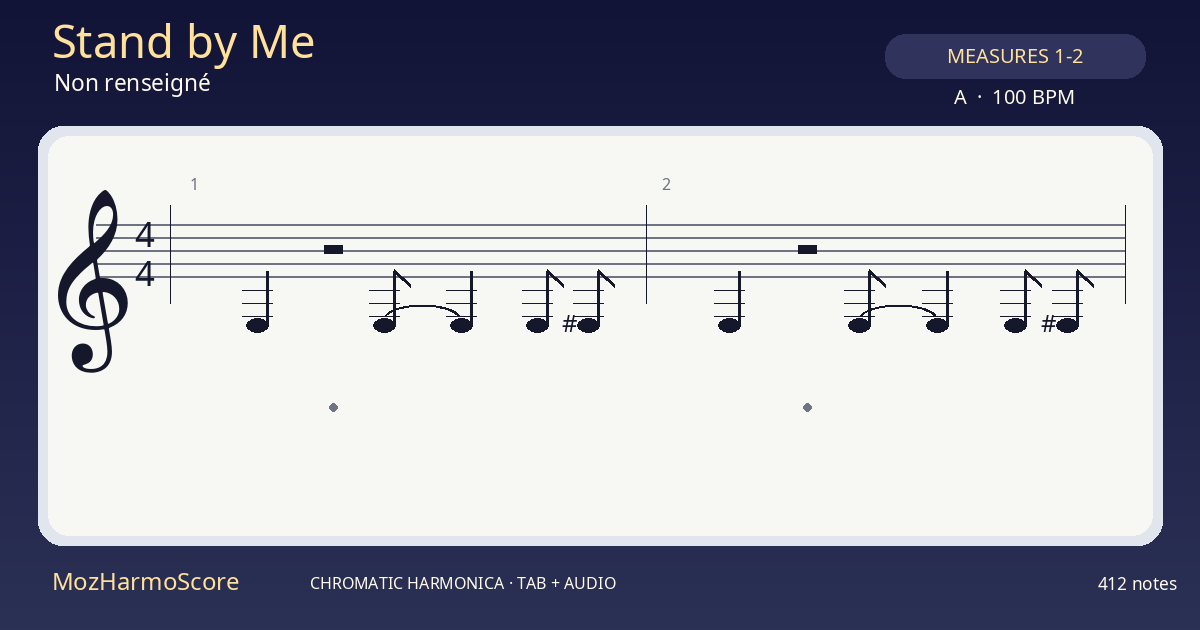
This imported score offers an intermediate-level challenge centered on melodic motif stability, sound continuity, and precise altered notes. Its apparent regularity requires true mastery: repeated phrases must stay lively, numerous ties must maintain their direction, and rests must contribute to phrasing. Start by identifying recurring cells before playing all 80 measures without interruption. Since the melody is familiar, use this opportunity to finely tune intonation, attack quality, and balance between breath, rhythm, and expression.
Presentation
This premium mini-course guides you through mastering Stand by Me on chromatic harmonica at an intermediate level. Over a few days, you will develop breath control, precise articulation of altered notes, and smooth legato playing. The course emphasizes steady rhythm and phrasing, helping you build confidence to perform the full 80-measure piece cleanly at 100 BPM. With clear practice goals and expert tips, you will improve your technical and musical skills while enjoying a familiar melody.
Why learn this piece
Learning this piece enhances your control over altered notes and legato phrasing, essential skills for expressive chromatic harmonica playing. Its moderate tempo and familiar melody make it ideal for developing breath management and rhythmic consistency.
Skills developed
Legato★★★★☆
Swing★★☆☆☆
Chromatic button★★★☆☆
Rhythm★★★☆☆
Speed★★☆☆☆
Expression★★★★☆
Music DNA
Jazz feeling35%
Expression82%
Technique100%
Breath100%
Reading100%
Improvisation35%
Rhythm100%
Chromatic button75%
AI musical analysis
The piece is set in A major at 100 BPM with 478 notes, including 137 altered notes (33%). It spans a wide range from D2 to A3 and features 158 ties and 66 rests. The dominant rhythm is eighth notes, with many repeated notes and large intervals up to an octave or more. The average breath length is about 6 notes, requiring careful breath planning and smooth chromatic button use.
Technical data
Notes412
Measures80
Tempo100 BPM
KeyA
Lowest noteD2
Highest noteA3
Max intervaloctave or more
Dominant rhythmeighth notes
Altered notes33%
Avg. breath6.1 notes
Fast rhythms0
Rests66
Repeated notes172
Ties158
Rangewide
Progression plan
Day 170 BPMSlow reading of the first two lines.
Day 280 BPMStabilize breath and ties.
Goal100 BPMPlay cleanly at target tempo.
Musical goals
- Reading in A major key
- Breath control and clean attacks
Common mistakes
- Increasing tempo before two clean slow readings
Coach tips
- Start at 75 BPM, then increase by 5 BPM only when the sound remains stable.