Echoes

David Gilmour, Roger Waters, Nick Mason, Richard Wright

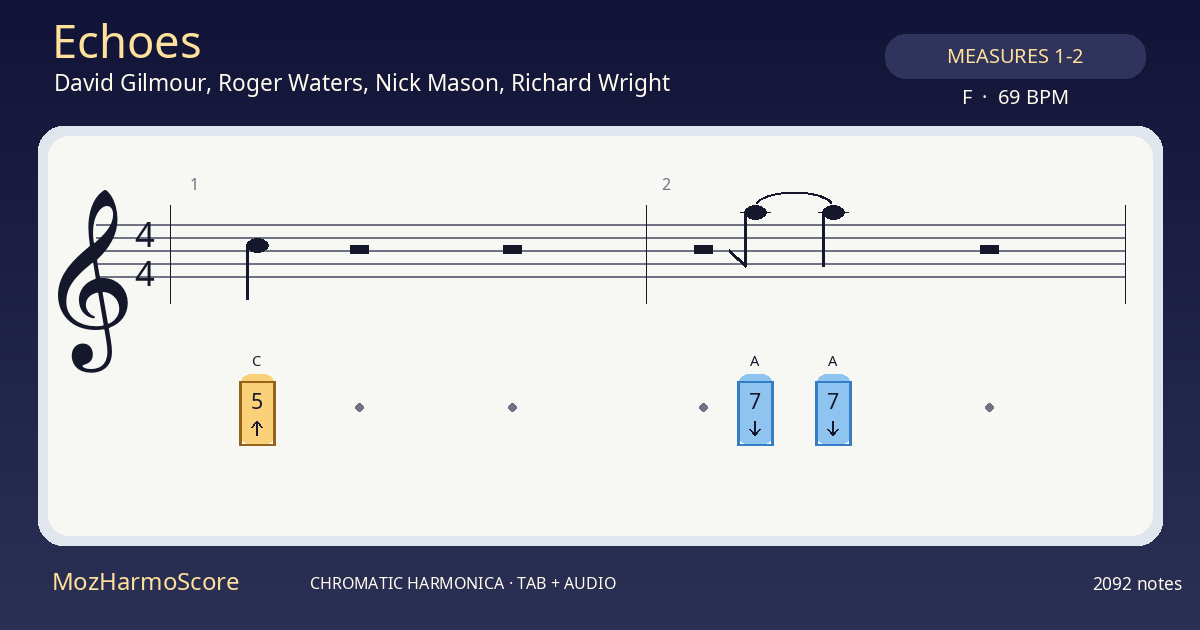
Free Echoes harmonica notes and tab for chromatic harmonica, synchronized with audio. Key F, 69 BPM — slow it down and practise.

Pop / varietyAdvanced2092 notesF69 BPM
MozHarmoScore

About this score

This extensive score requires a patient and structured approach. Its slow tempo does not make it simple: the wide range, many rests, and sequences of sixteenth notes demand confident reading and steady breath control. At the advanced level, the goal is to maintain musical continuity despite register changes and altered notes. Practice in short phrases, respecting written breaths, then gradually connect sections without artificially speeding up.

Presentation

Echoes is an advanced chromatic harmonica study designed as a long exercise in phrasing control and endurance. At 69 BPM, it spans a very wide range from C4 to G6, alternating breathed spaces, ties, and sixteenth note sequences. Numerous altered notes require reliable coordination with the chromatic button without hardening the attack. The priority is not raw speed but precise entries, rhythmic equality, and sound continuity. Approach each section separately before building long, expressive phrases.

Why learn this piece

This advanced piece develops mastery of long form: breath control, concentration, and rhythmic stability must be maintained over many measures. It also trains contrasts between rests, expressive ties, large register leaps, and altered notes.

Skills developed

Legato★★★★☆
Swing★★☆☆☆
Chromatic button★★☆☆☆
Rhythm★★★★☆
Speed★★★★☆
Expression★★★★☆

Music DNA

Jazz feeling35%
Expression100%
Technique100%
Breath100%
Reading100%
Improvisation35%
Rhythm100%
Chromatic button48%

AI musical analysis

The score contains 331 measures at a slow tempo of 69 BPM, where each rest must be precisely timed. The range from C4 to G6 demands wide leaps, sometimes an octave or more. Sixteenth notes dominate much of the writing, with 170 ties requiring controlled legato. The 439 altered notes increase demands for intonation and chromatic button coordination.

Technical data

Notes2092
Measures331
Tempo69 BPM
KeyF
Lowest noteC4
Highest noteG6
Max intervaloctave or more
Dominant rhythmsixteenth notes
Altered notes21%
Avg. breath9.9 notes
Fast rhythms1064
Rests300
Repeated notes647
Ties170
Rangewide

Progression plan

Day 150 BPM

Slow reading of the first two lines.

Day 260 BPM

Stabilize breath and ties.

Goal69 BPM

Play cleanly at target tempo.

Musical goals

  • Maintain a reliable internal pulse through rests and long phrases.
  • Control large register changes with steady attack.
  • Articulate even sixteenth notes at moderate tempo.
  • Link altered notes with accuracy and fluidity.

Common mistakes

  • Speeding up sixteenth notes when the phrase ascends to the high register.
  • Cutting ties due to lack of breath anticipation.
  • Forcing volume in the high register and destabilizing intonation.
  • Pressing too hard on the chromatic button during altered notes.

Coach tips

  • Record yourself at slow tempo: entries after rests quickly reveal timing issues.
  • Mentally sing the target note before each large register jump.
  • Break sixteenth note groups into consistent rhythmic cells.
  • Keep shoulders relaxed: body tension disrupts breath and intonation.

If you liked this piece

Tab analysis and practice

AI summary

Advanced journey through 331 measures: consolidate stability at 69 BPM, register shifts up to G6, ties, and numerous altered notes.

Suggested tempo42 -> 69 BPM

Practice goals

  • Stabilize slow phrases without losing pulse during rests.
  • Secure transitions between low, middle, and high registers across the full range.
  • Regularize groups of sixteenth notes before linking them.
  • Integrate altered notes with consistent intonation and relaxed technique.

Passages to isolate

  • Wide jumps to the high register, especially following short breaths.
  • Sixteenth note patterns mixing natural and altered notes.
  • Long ties requiring continuous and discreet airflow.
  • Phrase restarts after rests, precisely on the beat.

Focus points

  • Count rests internally: they structure entries as much as notes.
  • Mentally prepare register jumps before playing them.
  • Maintain moderate airflow in the high register to avoid forced attacks.
  • Isolate each altered note and verify its pitch before resuming rhythm.

Coach

  • Plan breaths at rests and tie endings; avoid filling every free space.
  • Work altered notes slowly with minimal pressure and clean attack on the chromatic button.
  • Use a metronome on beats, then on beats 2 and 4: sixteenth notes must remain even.
  • Do not confuse slowness with rhythmic looseness: entries after rests must stay perfectly timed.