Shine On You Crazy Diamond, Pt. 9
Pink Floyd
Free Shine On You Crazy Diamond, Pt. 9 harmonica notes and tab for chromatic harmonica, synchronized with audio. Key Bb, 42 BPM — slow it down and practise.
Pop / varietyIntermediate199 notesBb42 BPM
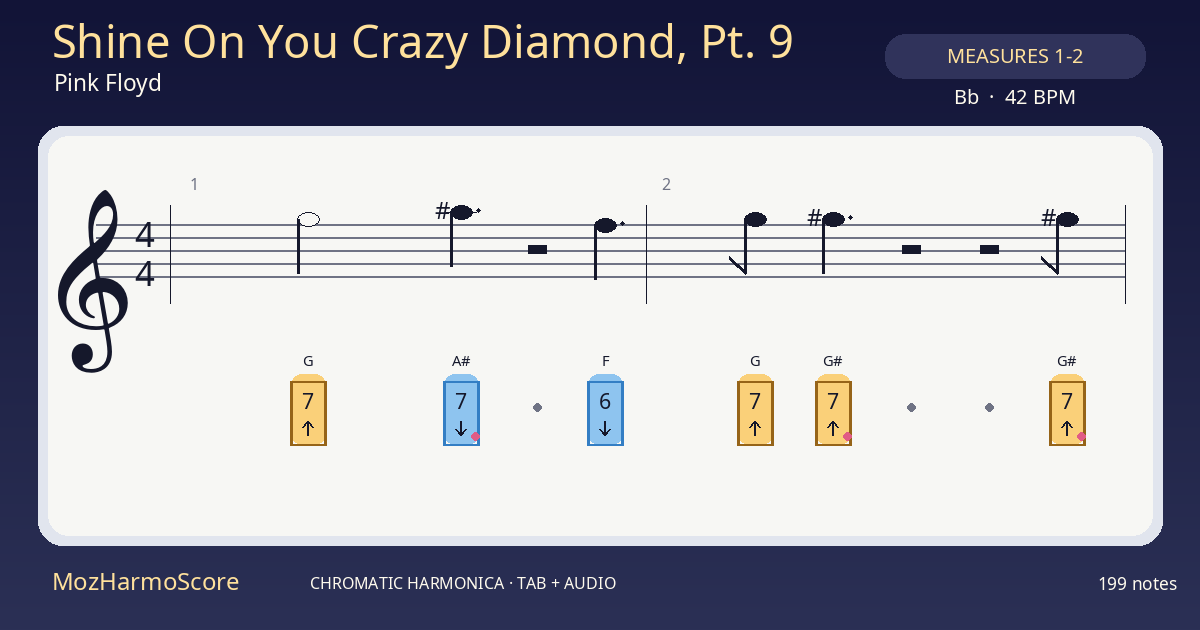
Free Shine On You Crazy Diamond, Pt. 9 harmonica notes and tab for chromatic harmonica, synchronized with audio. Key Bb, 42 BPM — slow it down and practise.
This part concludes Pink Floyd's iconic suite "Shine On You Crazy Diamond" in a slow, suspended, and expressive atmosphere. At 42 bpm, the challenge lies not in speed but in mastering timing, rests, and phrase continuity. The wide range requires careful preparation for register shifts. Approach it like a sung speech: give each phrase direction, allow rests to breathe, and avoid filling the spaces. On chromatic harmonica, the many altered notes must be subtle and perfectly in tune.
This premium mini-course guides you through mastering Shine On You Crazy Diamond Pt. 9 on chromatic harmonica. With its slow tempo and expressive phrasing, this piece develops your control over breath, timing, and subtle altered notes. You will learn to navigate wide intervals and long rests while maintaining musical flow. Step-by-step practice plans and focused exercises help you build precision and musicality, making this an ideal study for intermediate players aiming to deepen their expressive skills.
Learning this piece enhances your ability to control slow phrasing, manage altered notes cleanly, and handle wide register shifts with musical sensitivity.
The piece features 252 notes over 33 measures at 42 bpm in Bb major, with a wide range from E4 to G#6. Nearly 29% of the notes are altered, requiring precise button technique. The dominant rhythm is sixteenth notes, with frequent ties and rests demanding careful breath control. Intervals reach up to a sixth, challenging smooth register transitions.
Slow reading of the first two lines.
Stabilize breath and phrase connections.
Play cleanly at the target tempo.
This intermediate score has 33 measures at a very slow tempo, spanning from E4 to G#6. Isolate groups of sixteenth notes, ties, and jumps up to a sixth, then place them back within their surrounding silence. The 58 altered notes require precise button preparation and attentive tuning.