Everybody Hurts

R.E.M.

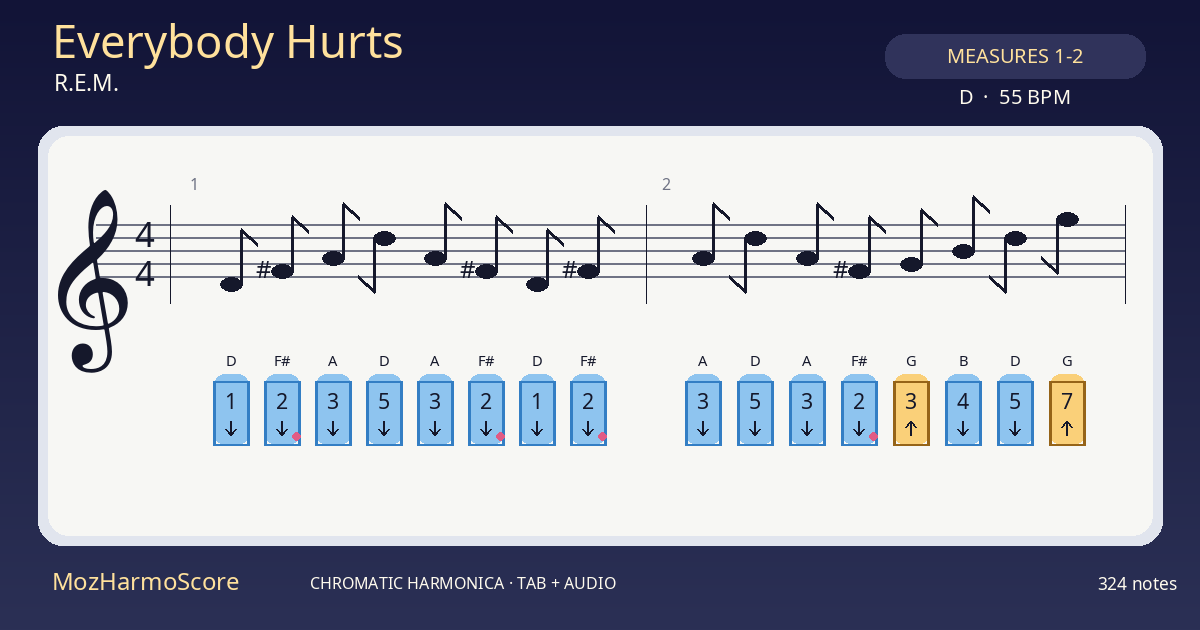
Free Everybody Hurts harmonica notes and tab for chromatic harmonica, synchronized with audio. Key D, 55 BPM — slow it down and practise.

Pop / varietyIntermediate324 notesD55 BPM
MozHarmoScore

About this score

This pop ballad invites a restrained playing style where the quality of each note matters more than speed. At 55 BPM, the intermediate challenge is to maintain a steady pulse without weighing down long notes or rushing the eighth notes. The melody spans a wide range from C#4 to B5, requiring calm shifts between low and high registers. The many rests serve as true musical spaces: prepare your breath and let the phrase breathe. Start by ensuring smooth melodic continuity, then gradually add subtle dynamics and gentle articulation.

Presentation

Everybody Hurts is an excellent intermediate chromatic harmonica study of a pop ballad. Set in D major at 55 BPM, it emphasizes singing quality, breath control, and rhythmic precision over fast virtuosity. Its wide range from C#4 to B5 demands solid instrument landmarks and relaxed shifts. Numerous breaths, ties, and sustained notes require attentive duration listening. The 55 altered notes call for precise and stable chromatic button use. Approach each phrase like a vocal line: soft start, continuous melody, embraced silence, and tension-free arrival.

Why learn this piece

This piece develops expressive, controlled playing at a slow tempo where every irregularity is audible. It strengthens reading of rests, ties, and altered notes within an accessible intermediate pop melody. It also helps learn how to shape a phrase without overplaying.

Skills developed

Legato★★★★☆
Swing★★☆☆☆
Chromatic button★★☆☆☆
Rhythm★★★★☆
Speed★★★★☆
Expression★★★★☆

Music DNA

Jazz feeling35%
Expression78%
Technique100%
Breath100%
Reading97%
Improvisation35%
Rhythm100%
Chromatic button35%

AI musical analysis

In D major, the melody relies on a slow 55 BPM pulse and mostly eighth notes, punctuated by many long notes. The range is wide, from C#4 to B5, with intervals reaching an octave or more, requiring anticipation of register changes. The 55 altered notes demand precise, stable chromatic button action. The 89 rests and 50 ties structure the breath; respecting them preserves the piece’s calm character.

Technical data

Notes324
Measures84
Tempo55 BPM
KeyD
Lowest noteC#4
Highest noteB5
Max intervaloctave or more
Dominant rhythmeighth notes
Altered notes17%
Avg. breath7.7 notes
Fast rhythms12
Rests89
Repeated notes65
Ties50
Rangewide

Progression plan

Day 150 BPM

Slow reading of the first two lines.

Day 255 BPM

Stabilize breath and ties.

Goal55 BPM

Play cleanly at target tempo.

Musical goals

  • Sustain a slow melody with steady, nuanced breath.
  • Master shifts between low, middle, and high registers.
  • Integrate accurate altered notes within legato playing.
  • Maintain a reliable pulse through rests and ties.

Common mistakes

  • Lengthening or shortening rests instead of counting them.
  • Forcing long notes, which hardens tone and tires breath.
  • Engaging the chromatic button too late on altered notes.
  • Speeding up eighth notes after large register jumps.

Coach tips

  • Sing each phrase before playing to clarify breaths and musical direction.
  • Mark rests in the score and prepare the next shift during them.
  • For large jumps, first target the arrival note without rhythm, then restore the pulse.
  • Record yourself at target tempo, focusing on stable note endings and re-entries.

If you liked this piece

Tab analysis and practice

AI summary

Slow ballad in D major: stabilize the pulse, manage wide register shifts, and play 55 altered notes smoothly without breaking the legato.

Suggested tempo40 -> 55 BPM

Practice goals

  • Keep a steady pulse at 55 BPM despite the rests.
  • Connect low and high registers cleanly over wide intervals.
  • Produce accurate and discreet altered notes within the melody.
  • Build a gradual dynamic curve without speeding up.

Passages to isolate

  • Jumps between middle and high registers up to B5.
  • Sequences involving C#4 and other altered notes.
  • Long notes followed by rests or soft re-entries.
  • Groups of eighth notes after a breath, maintaining evenness.

Focus points

  • Count rests internally to support the pulse.
  • Prepare shifts before wide intervals without sliding between notes.
  • Renew air quietly during rests rather than at phrase ends.
  • Keep eighth notes light and even, even at slow tempo.

Coach

  • Play long notes with very steady airflow; avoid pushing sound at the end of breath.
  • Isolate altered notes slowly with the chromatic button and tuner before reintegrating them into the phrase.
  • Use a metronome subdividing each beat into eighth notes, and keep this reference during rests.
  • Do not confuse slowness with tempo freedom: re-entries after rests must land precisely on the beat.