Far Side of Home

Original study for MozScore

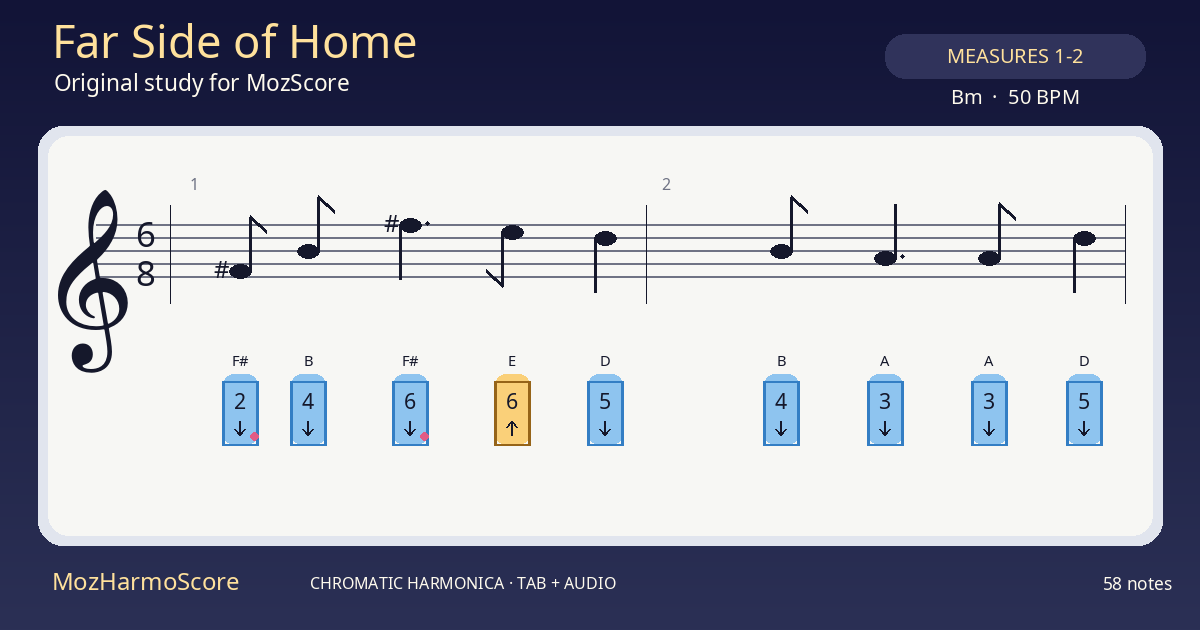
Free Far Side of Home harmonica notes and tab for chromatic harmonica, synchronized with audio. Key Bm, 50 BPM — slow it down and practise.

Pop / varietyIntermediate58 notesBm50 BPM
MozHarmoScore

About this score

Far Side of Home is an original MozScore study designed to develop expressive melodic phrasing in an intimate pop setting. Its slow tempo allows time to listen to each connection, while the wide range and numerous altered notes require careful preparation. Approach it like a story: establish a calm pulse, breathe naturally at phrase endings, and guide the climbs to the higher register. The goal is not speed but a stable, singing line perfectly controlled across the full range.

Presentation

Far Side of Home is an original pop study for intermediate chromatic harmonica players. Written in B minor at 50 bpm, it emphasizes a calm melodic line supported by steady eighth notes and longer values. Its technical interest lies in the wide range from F#4 to D6 and frequent use of altered notes. The slow tempo does not simplify the exercise; it immediately reveals any imprecision in rhythm, breath, and intonation. Aim for a round tone, silent shifts, and expressive continuity between phrases.

Why learn this piece

This study strengthens control over a wide range and accuracy of altered notes within a musically accessible intermediate framework. It also trains maintaining a reliable pulse at a slow tempo where every attack and connection remains audible. It is excellent preparation for expressive pop melodies requiring wide interval jumps.

Skills developed

Legato★★★☆☆
Swing★★☆☆☆
Chromatic button★★★☆☆
Rhythm★★★☆☆
Speed★★☆☆☆
Expression★★★★☆

Music DNA

Jazz feeling35%
Expression58%
Technique81%
Breath50%
Reading52%
Improvisation35%
Rhythm45%
Chromatic button81%

AI musical analysis

Set in B minor, the melody has an introspective color, while the steady eighth notes maintain a regular flow. The range spans from F#4 to D6, including several large intervals such as octave jumps or more. The 18 altered notes form a significant part of the line and require precise coordination with the chromatic button. At 50 bpm, the longer note values invite control of tone sustain and phrase endings.

Technical data

Notes58
Measures15
Tempo50 BPM
KeyBm
Lowest noteF#4
Highest noteD6
Max intervaloctave or more
Dominant rhythmeighth notes
Altered notes31%
Avg. breath9.7 notes
Fast rhythms0
Rests0
Repeated notes2
Ties0
Rangewide

Progression plan

Day 150 BPM

Slowly read through the first two lines.

Day 250 BPM

Stabilize breath and note connections.

Goal50 BPM

Play cleanly at the target tempo.

Musical goals

  • Coordinate the chromatic button with discreet, accurate articulation.
  • Navigate large intervals without losing tone stability.
  • Maintain steady eighth notes in a slow, expressive melody.
  • Manage breath over a continuous line covering a wide range.

Common mistakes

  • Unconsciously speeding up before or after large jumps.
  • Attacking high notes with excessive breath pressure.
  • Triggering the chromatic button too late on altered notes.
  • Allowing long notes to fall short of their full duration.

Coach tips

  • Mentally sing the target note of each large jump before playing it.
  • Record yourself at low volume to better hear intonation flaws.
  • Practice altered notes in isolation, then immediately place them back in context.
  • Allow a micro-relaxation in the mouth between distant registers without breaking the pulse.

If you liked this piece

Tab analysis and practice

AI summary

At 50 bpm in B minor, this study works on steady eighth notes, wide register shifts, and 18 altered notes. Isolate the climbs to B5 and D6 before linking phrases.

Suggested tempo40 -> 50 BPM

Practice goals

  • Maintain steady eighth notes without rushing during climbs.
  • Prepare register shifts with minimal movement.
  • Secure altered notes within their melodic context.
  • Build connected phrases with controlled note endings.

Passages to isolate

  • Jumps from F#4 to F#5, then to B5.
  • The climb from B5 to D6 followed by stepwise descent.
  • Sequences involving A#4, C#, and other altered notes.
  • Quick returns to the mid register after high notes.

Focus points

  • Keep a soft, continuous airflow on long notes.
  • Internally count eighth notes even when the melody feels free.
  • Anticipate mouth movement before large intervals.
  • Check tuning of each altered note at low volume.

Coach

  • Distribute air evenly across each phrase and release pressure before high note attacks.
  • Prepare the chromatic button just before altered notes without holding it unnecessarily.
  • Use a metronome placing each eighth note at the pulse center.
  • Avoid compensating large jumps with excessive breath pressure, which hardens tone and detunes attacks.