Glass Current
Original study for MozScore
Free Glass Current harmonica notes and tab for chromatic harmonica, synchronized with audio. Key Am, 58 BPM — slow it down and practise.
Studies / exercisesBeginner58 notesAm58 BPM
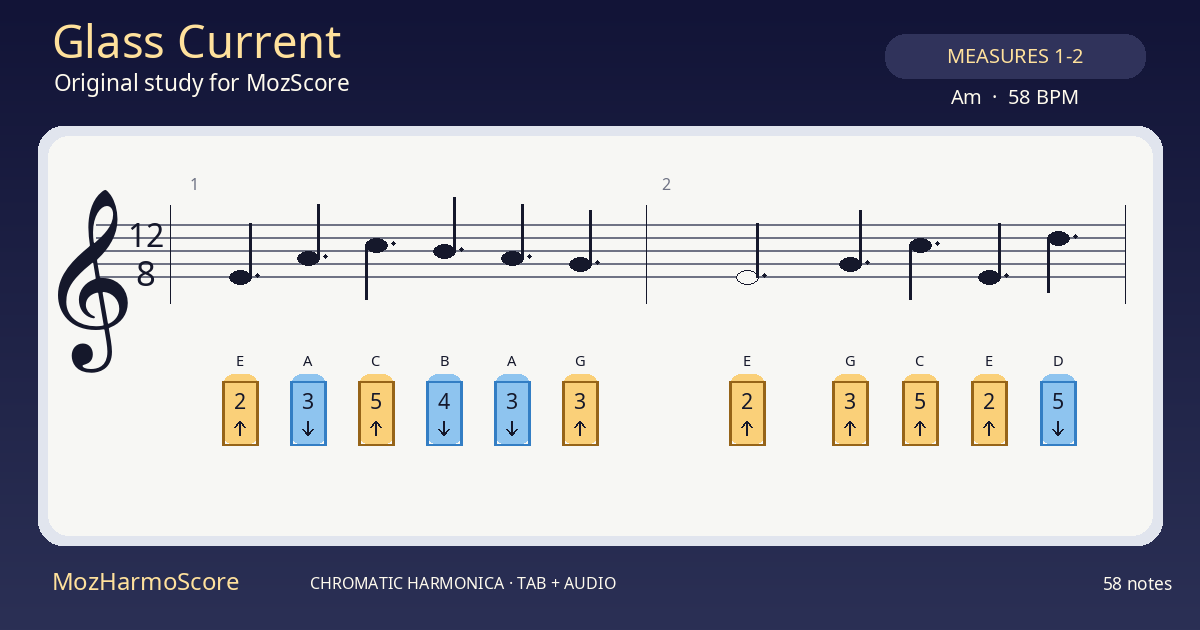
Free Glass Current harmonica notes and tab for chromatic harmonica, synchronized with audio. Key Am, 58 BPM — slow it down and practise.
Glass Current is a short original study designed as a first soundscape on the chromatic harmonica. Its calm movement allows time to listen to each note, stabilize the embouchure, and feel the difference between blow and draw. The A minor key adds a soft, slightly contemplative color without requiring speed. Begin by practicing groups of four notes, then connect them with a gentle, continuous breath. The two altered notes offer a good opportunity to discover the chromatic button without rushing: prepare the button press before playing the note.
Glass Current is an original study to explore the chromatic harmonica with calmness. At 58 bpm, its steady quarter notes provide a clear framework to learn melodic reading, alternate blow and draw, and keep tempo. The melody spans a medium range from low C4 to high D5, with some jumps to prepare carefully. Two altered notes introduce the chromatic button briefly, without adding technical difficulty. To start well, play softly measure by measure, then connect phrases while maintaining a stable pulse and round tone.
This study offers beginners a comfortable tempo to establish a clean sound and reliable pulse. It also introduces two altered notes in a simple, slow musical context.
Written in A minor, the piece has 11 measures mainly in quarter notes at 58 bpm. The melody ranges from C4 to D5, suitable for first instrument exploration. Mostly stepwise motion dominates, but some jumps up to a seventh require visualizing the target note. Two brief altered notes require precise, short chromatic button presses.
Slow reading of the first two lines.
Stabilize breath and legato connections.
Play cleanly at the target tempo.
Slow study in A minor focusing on steady quarter notes, breath direction changes, and two notes with the chromatic button.