L'emozione non ha voce

Adriano Celentano (artiste)

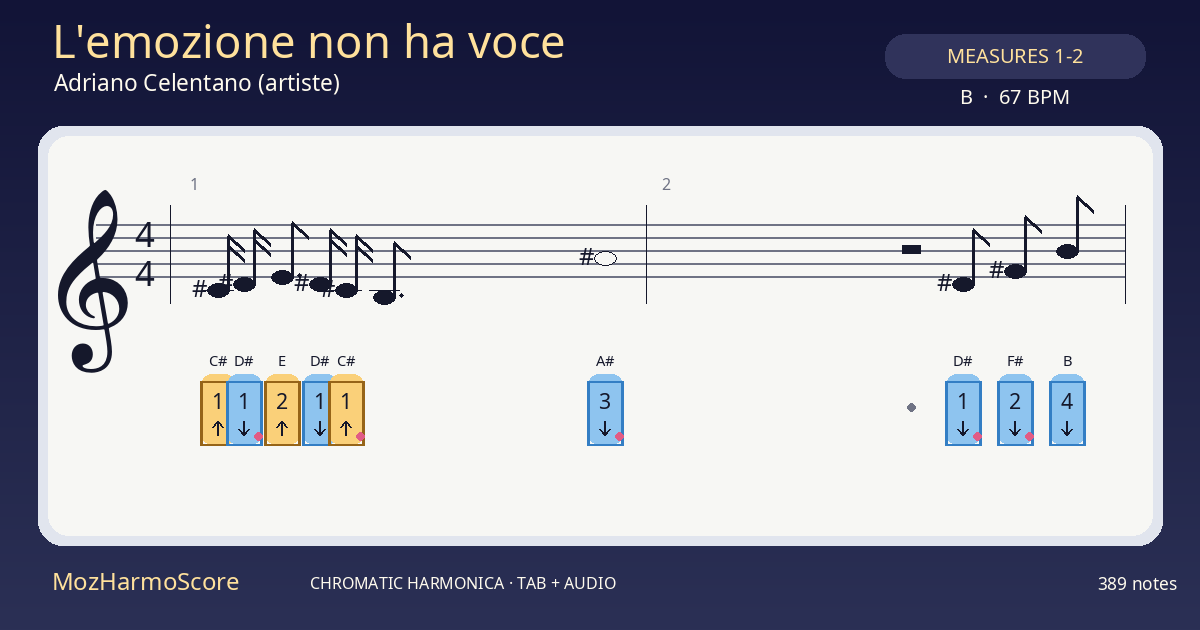
Free L'emozione non ha voce harmonica notes and tab for chromatic harmonica, synchronized with audio. Key B, 67 BPM — slow it down and practise.

Pop / varietyAdvanced389 notesB67 BPM
MozHarmoScore

About this score

This adaptation treats the melody as a broad vocal line without sacrificing precision in numerous chromatic shifts. At 67 BPM, the apparent slowness exposes each attack clearly, requiring focus on breath continuity, pitch accuracy, and note stability. Begin by identifying structural breaths rather than taking air at every silence. Mentally prepare large intervals before moving the instrument. Once fingerings are secure, explore gradual dynamics and measured vibrato to maintain controlled expression.

Presentation

This advanced score demands precise pop phrasing on a slow but very exposed melody. Its B major key, numerous chromatic shifts, and range from B3 to G#5 require confident reading and excellent coordination. Sixteenth notes, tied notes, and wide intervals must be integrated into a smooth line without breaking breath flow. The goal is not just to reach 67 BPM but to preserve intonation, attack quality, and gradual expression in every phrase.

Why learn this piece

This piece develops advanced legato control, chromatic button mastery, and large register shifts. It also trains expressive interpretation at a slow tempo where every imprecision is audible.

Skills developed

Legato★★★★☆
Swing★★☆☆☆
Chromatic button★★★★★
Rhythm★★★★☆
Speed★★★★☆
Expression★★★★☆

Music DNA

Jazz feeling35%
Expression80%
Technique100%
Breath100%
Reading100%
Improvisation35%
Rhythm100%
Chromatic button100%

AI musical analysis

Spanning 58 measures at 67 BPM, the piece covers a wide tessitura from B3 to G#5. Sixteenth notes dominate the fast writing, while many ties extend phrases and complicate breath management. About 60% of notes require chromatic button use, demanding precise coordination. Intervals up to an octave or more emphasize the advanced challenge of pitch accuracy and placement.

Technical data

Notes389
Measures58
Tempo67 BPM
KeyB
Lowest noteB3
Highest noteG#5
Max intervaloctave or more
Dominant rhythmsixteenth notes
Altered notes60%
Avg. breath7.9 notes
Fast rhythms223
Rests58
Repeated notes109
Ties64
Rangewide

Progression plan

Day 150 BPM

Slow reading of the first two lines.

Day 260 BPM

Stabilize breath and ties.

Goal67 BPM

Play cleanly at target tempo of 67 BPM.

Musical goals

  • Advanced coordination of breath, articulation, and chromatic button.
  • Legato mastery in phrases with tied notes.
  • Precision in large intervals across a wide range.
  • Expressive control of dynamics and attacks at slow tempo.

Common mistakes

  • Releasing the button before the chromatic note ends.
  • Speeding up sixteenth notes after long values or rests.
  • Attacking high notes too strongly after large intervals.
  • Exhausting breath by playing all phrases with the same intensity.

Coach tips

  • Record slow takes to detect button noise and overly marked attacks.
  • Visualize the target note before large jumps to prepare the move.
  • Practice without vibrato first, adding it only on perfectly stable notes.
  • Alternate isolated passages and full runs to maintain musical continuity.

If you liked this piece

Tab analysis and practice

AI summary

Advanced 58-measure score in B major featuring a wide range, many sixteenth notes, 64 ties, and heavy chromatic button use. The main challenge is maintaining expressive legato despite register changes and fast note groups.

Suggested tempo44 -> 67 BPM

Practice goals

  • Stabilize chromatic transitions at slow tempo without button noise.
  • Connect sustained notes and sixteenth notes within a continuous breath flow.
  • Anticipate octave or larger jumps without unintended accents.

Passages to isolate

  • Isolate sixteenth-note groups with multiple successive button changes.
  • Practice jumps between low and high registers separately.
  • Resume tied notes after rests without perceptible new attacks.

Focus points

  • Maintain a steady internal pulse during long notes and rests.
  • Plan breaths before long phrases rather than urgently during them.
  • Synchronize tongue, breath, and button during rapid chromatic changes.

Coach

  • Use a steady, moderate airflow; recover discreetly during rests without overfilling the lungs.
  • Keep the thumb in contact with the button, applying brief, complete pressure perfectly timed with note changes.
  • Practice sixteenth notes in groups of four with a metronome, then reintegrate ties and dotted rhythms.
  • Watch for harsh attacks after rests, delayed button presses, and speeding up repeated note groups.