Marée silencieuse

Original study generated for Frank / MozScore

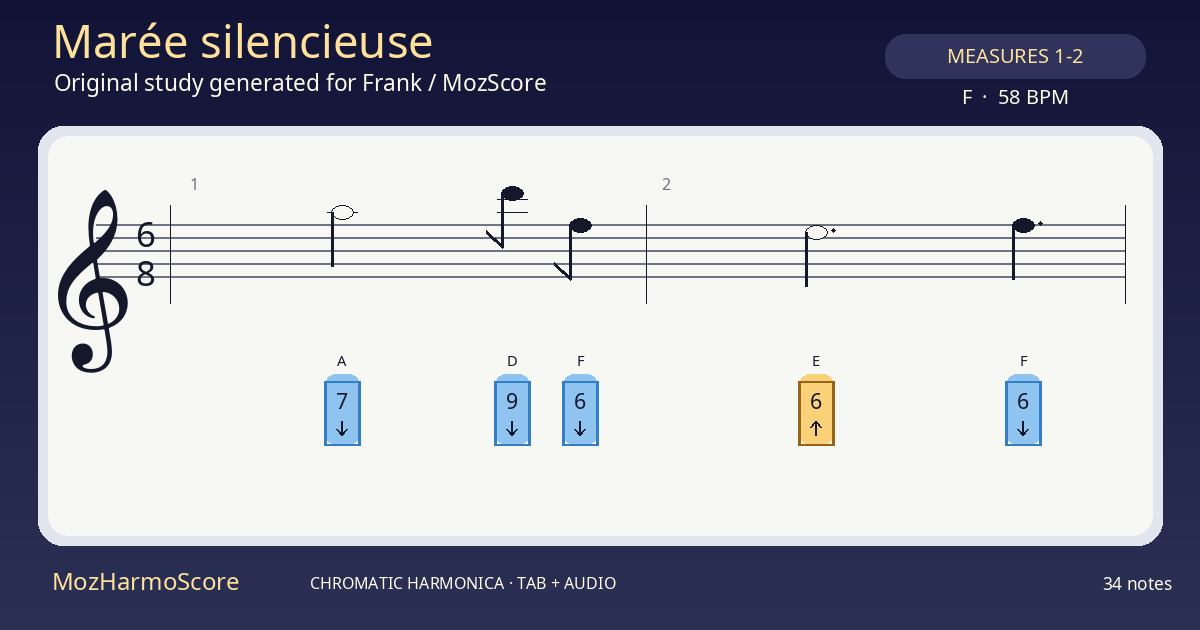
Free Marée silencieuse harmonica notes and tab for chromatic harmonica, synchronized with audio. Key F, 58 BPM — slow it down and practise.

Studies / exercisesEasy34 notesF58 BPM
MozHarmoScore

About this score

Silent Tide is a short original study designed as a calm and steady melodic line. Its slow tempo allows you to listen carefully to each note, focus on smooth connections, and build a stable breath without rushing. The melody covers a fairly wide range while remaining accessible thanks to long note values and simple rhythms. Approach it as a gentle sound walk: keep a relaxed pulse, let sustained notes resonate, and prepare the few altered notes before playing them. This attentive approach highlights its peaceful character.

Presentation

Silent Tide is an easy chromatic harmonica study in F major at a calm tempo of 58 BPM. Its melody emphasizes quarter notes, eighth notes, and sustained tones, allowing time to develop a beautiful sound. The range spans from low A4 to high D6, including some jumps to prepare calmly. Five altered notes invite precise chromatic button work without weighing down the phrasing. Play this piece with a peaceful pulse, subtle attacks, and attentive listening to phrase continuity.

Why learn this piece

This easy study helps develop a singing, steady playing style at a comfortable tempo. It combines breath control, tone holding, register changes, and initial altered notes in a short melody. It is an excellent exercise to learn preparing gestures without losing phrasing simplicity.

Skills developed

Legato★★★☆☆
Swing★★☆☆☆
Chromatic button★★☆☆☆
Rhythm★★★☆☆
Speed★★☆☆☆
Expression★★★★☆

Music DNA

Jazz feeling35%
Expression57%
Technique55%
Breath50%
Reading49%
Improvisation35%
Rhythm45%
Chromatic button38%

AI musical analysis

Set in F major, the melody provides a clear tonal framework, with five altered notes adding occasional color. The slow tempo of 58 BPM and absence of fast rhythms support precise pulse work. The melody covers a wide range with a maximum interval of a sixth, approached without tension. Numerous sustained notes require stable breath and careful legato.

Technical data

Notes34
Measures13
Tempo58 BPM
KeyF
Lowest noteA4
Highest noteD6
Max intervalsixth
Dominant rhythmquarter notes
Altered notes15%
Avg. breath6.8 notes
Fast rhythms0
Rests0
Repeated notes1
Ties0
Rangewide

Progression plan

Day 150 BPM

Slow reading of the first two lines.

Day 258 BPM

Stabilize breath and legato.

Goal58 BPM

Play cleanly at target tempo.

Musical goals

  • Sustain a steady tone on long notes.
  • Play even eighth notes at a slow tempo.
  • Prepare register jumps precisely.
  • Integrate chromatic altered notes smoothly in simple phrases.

Common mistakes

  • Forcing breath on sustained notes instead of letting sound resonate.
  • Arriving late on eighth notes after a half or dotted note.
  • Searching for high notes with too much breath pressure.
  • Pressing the chromatic button too late on altered notes.

Coach tips

  • Mentally sing the phrase before playing to anticipate its direction.
  • Practice each jump two or three times, then return immediately to the full phrase.
  • Focus on sound quality over volume on long notes.
  • Keep shoulders relaxed; tension hinders breath and button action.

If you liked this piece

Tab analysis and practice

AI summary

This easy study in F major is played at 58 BPM, featuring quarter notes, eighth notes, and several sustained notes. Isolate the register jumps and the five altered notes, then connect the phrases with calm and steady breath.

Suggested tempo46 -> 58 BPM

Practice goals

  • Maintain a steady pulse at 58 BPM.
  • Prepare the five altered notes without interrupting the melody.
  • Link long notes with a stable and soft tone.
  • Secure the jumps between low and high registers.

Passages to isolate

  • The beginning, connecting a sustained note to the jump into the high register.
  • Transitions around the altered note near the phrase ending.
  • The descending passage gradually returning to the mid register.
  • The conclusion, where the final sustained note requires steady breath.

Focus points

  • Count quarter and eighth notes internally to avoid stretching the rhythm.
  • Prepare register changes before the jump without pushing the breath.
  • Keep a moderate volume to stabilize sustained notes.
  • Anticipate altered notes with a brief, precise, and relaxed chromatic button action.

Coach

  • Use a flexible, gentle breath; discreetly renew air between long phrases.
  • Identify the five altered notes separately, then add the chromatic button action at the slow tempo.
  • Practice with a metronome feeling each quarter note; keep eighth notes even and light.
  • Do not rush the eighth notes following long notes; maintain exactly the same pulse.