Mia and Sebastian's Theme
Non renseigné
Free Mia and Sebastian's Theme harmonica notes and tab for chromatic harmonica, synchronized with audio. Key A, 100 BPM — slow it down and practise.
Movies & TVIntermediate71 notesA100 BPM
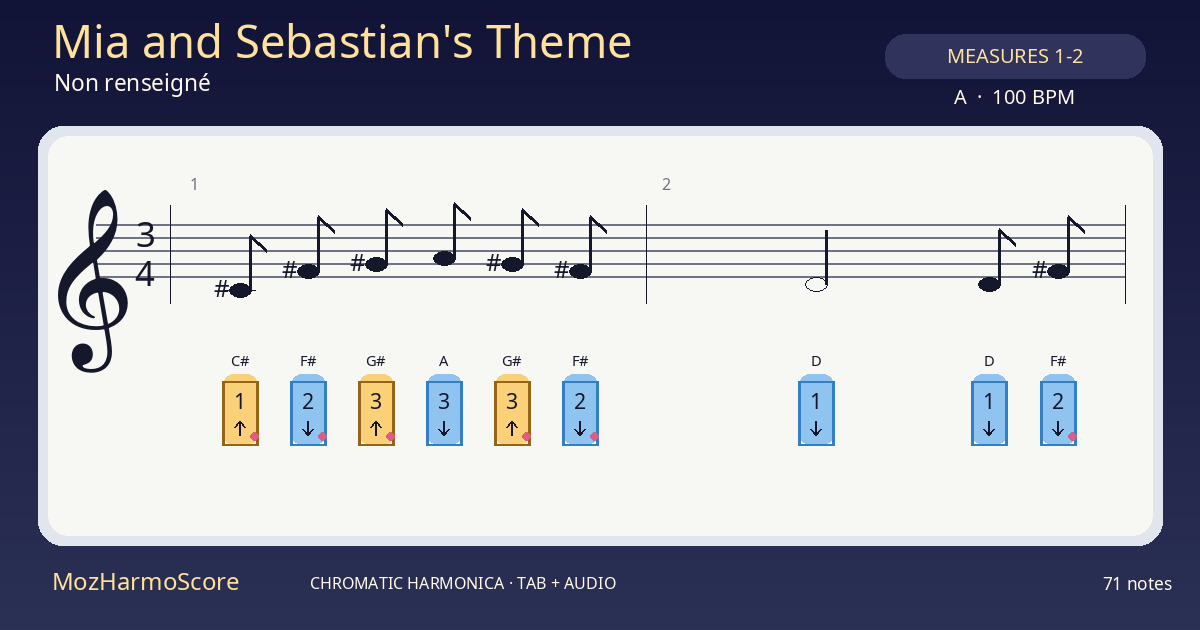
Free Mia and Sebastian's Theme harmonica notes and tab for chromatic harmonica, synchronized with audio. Key A, 100 BPM — slow it down and practise.
This movie theme features a clear melodic line whose apparent simplicity requires true instrumental control. On the chromatic harmonica, its interest lies in the contrast between stepwise motifs, long notes, and shifts to the high register. The score contains many altered notes and no written rests, so breathing must be carefully organized without interrupting the musical flow. To maintain a singing character, practice the transitions slowly at first, then add dynamics. At this intermediate level, the goal is to make register changes and button actions nearly imperceptible.
This premium mini-course guides you through the intermediate challenges of 'Mia and Sebastian's Theme' on chromatic harmonica. Over 17 measures, you will develop legato phrasing, precise altered note control, and smooth register transitions. The course emphasizes breath management without written rests and mastering wide intervals up to an octave or more. Step-by-step practice plans and coach tips help you build a singing tone and flawless technique at a moderate tempo of 100 BPM.
Learning this piece enhances your ability to control legato phrasing, manage complex altered notes, and navigate wide intervals and register shifts smoothly—key skills for expressive chromatic harmonica playing.
The piece is set in A major at 100 BPM, spanning 17 measures with 71 notes, 63% of which are altered. The range extends widely from C#4 to B5, with intervals reaching an octave or more. The dominant rhythm is steady eighth notes, and the melody requires continuous airflow without rests, demanding precise breath and button coordination.
Slow reading of the first two lines
Stabilize breath and legato connections
Play cleanly at target tempo of 100 BPM
Intermediate work focused on legato, precise control of 45 altered notes, managing a wide range from C#4 to B5, and preparing intervals up to an octave or more.