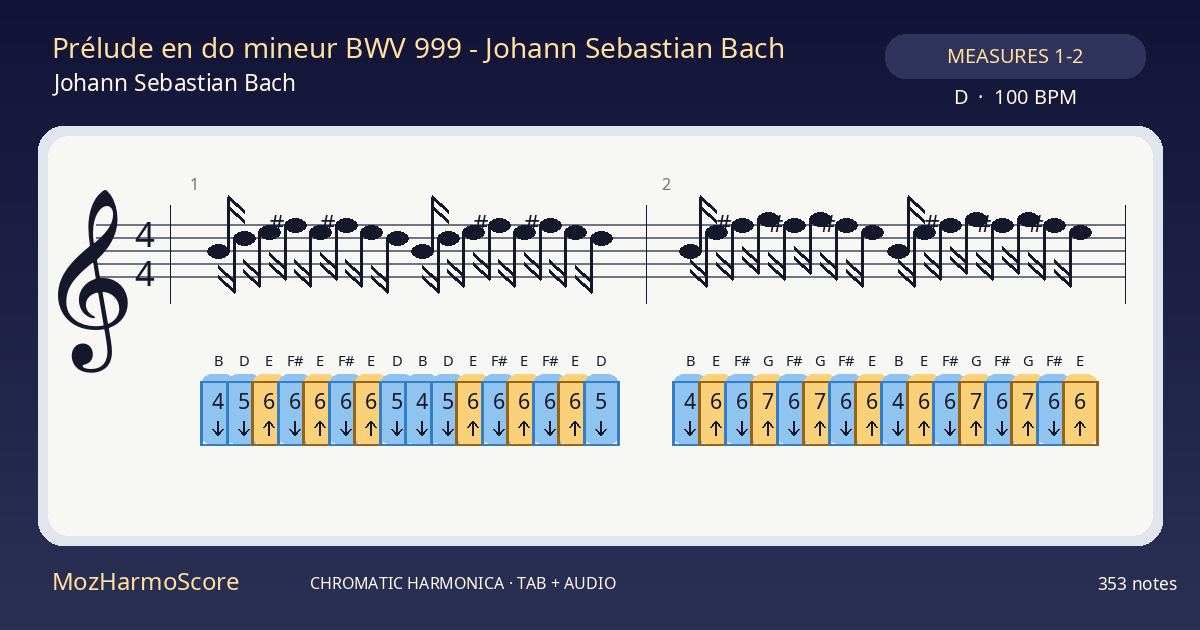
Presentation
This premium mini-course guides you through learning Bach's Prelude in D Minor BWV 999 on chromatic harmonica. You will learn to manage numerous altered notes and a fast sixteenth-note rhythm while developing finger agility and breath control. This classical piece is ideal for beginners aiming to progress toward more expressive and technical playing.
Why learn this piece
This prelude is a timeless classic that develops mastery of chromatic alterations and rhythmic precision on the chromatic harmonica.
Skills developed
Legato★★★☆☆
Swing★★☆☆☆
Chromatic button★★★☆☆
Rhythm★★★★☆
Speed★★★★☆
Expression★★★★☆
Music DNA
Jazz feeling35%
Expression75%
Technique100%
Breath50%
Reading89%
Improvisation35%
Rhythm100%
Chromatic button94%
AI musical analysis
The piece spans a wide range from D4 to D6 and features 36% altered notes. Its dominant rhythm is steady sixteenth notes, requiring excellent breath-finger coordination and careful attention to altered note changes to preserve the Baroque melodic style.
Technical data
Notes353
Measures23
Tempo100 BPM
KeyD
Lowest noteD4
Highest noteD6
Max intervaloctave or more
Dominant rhythmsixteenth notes
Altered notes36%
Avg. breath11.8 notes
Fast rhythms352
Rests0
Repeated notes1
Ties0
Rangewide
Progression plan
Day 175 BPMSlow reading of the first two lines.
Day 290 BPMStabilize breath and note transitions.
Goal100 BPMPlay cleanly at target tempo.
Musical goals
- Mastery of chromatic alterations
- Breath and respiratory control
- Rhythmic precision in sixteenth notes
- Finger agility on the instrument
Common mistakes
- Confusion or delay in chromatic button use
- Irregular breathing causing sound breaks
- Uneven rhythm in sixteenth notes
- Lack of clarity in altered notes
Coach tips
- Take deep breaths before fast phrases to maintain stable sound.
- Use a metronome to keep a steady rhythm.
- Repeat altered note changes to improve button-finger coordination.