Sailing
Rod Stewart
Free Sailing harmonica notes and tab for chromatic harmonica, synchronized with audio. Key C, 67 BPM — slow it down and practise.
Pop / varietyIntermediate139 notesC67 BPM
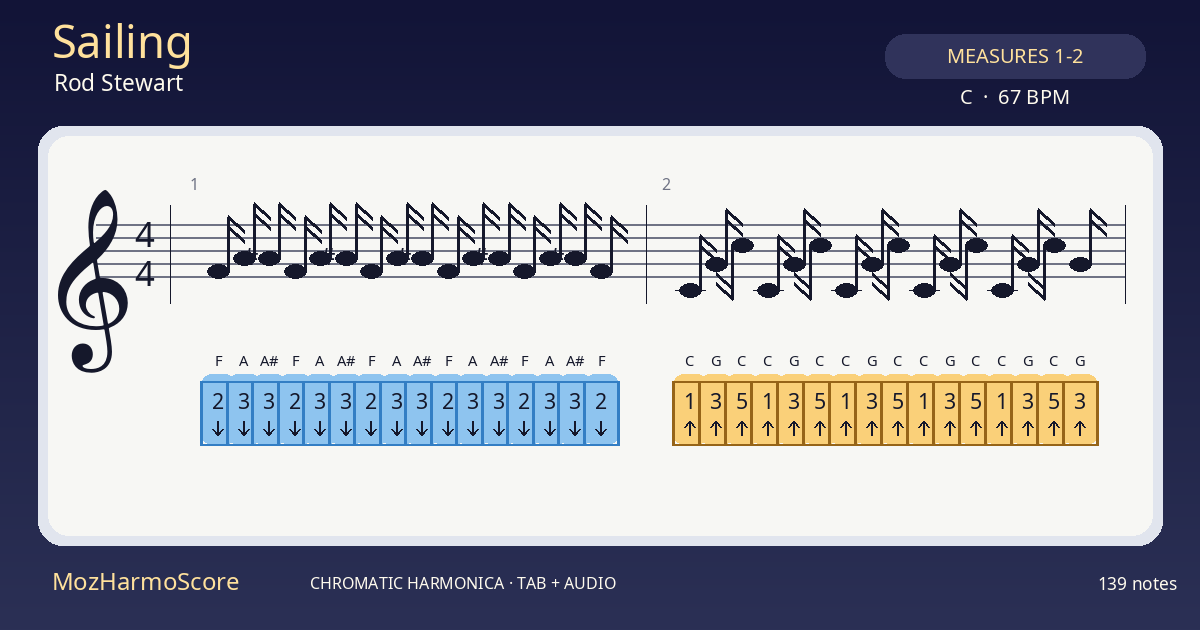
Free Sailing harmonica notes and tab for chromatic harmonica, synchronized with audio. Key C, 67 BPM — slow it down and practise.
Popularized by Rod Stewart, Sailing suits a broad and expressive interpretation on the chromatic harmonica. This arrangement requires solid intermediate skills: fast note groups, repeated notes, and wide register shifts must stay fluid despite the moderate tempo. Begin by playing the melody softly, then gradually build dynamics. The altered notes demand precise chromatic button coordination without thumb tension or breath breaks. The main challenge is to keep the singing character of the melody while securing large jumps and long phrases with few rests.
This premium mini-course guides you through mastering Sailing on the chromatic harmonica at an intermediate level. You will develop breath control, precise chromatic button use, and fluid phrasing across a wide range. The course breaks down challenging passages, focusing on steady rhythm and expressive playing. With a clear progression plan and expert tips, you will build confidence to perform this expressive pop piece smoothly at the target tempo.
Learning Sailing enhances your ability to handle wide intervals, maintain steady breath flow, and coordinate the chromatic button in expressive pop melodies. It strengthens your control over sixteenth note rhythms and register shifts, essential skills for versatile chromatic harmonica playing.
The piece is in C major at 67 BPM, featuring 142 notes with 10 altered notes (7%). It spans from C4 to A5, covering a wide range with intervals up to an octave or more. The rhythm is dominated by sixteenth notes, with 58 fast rhythms and 30 repeated notes. Breath management is crucial due to long phrases with few rests.
Slow reading of the first two lines
Stabilize breath and note connections
Play cleanly at the target tempo of 67 BPM
The score features dominant sixteenth notes, thirty repeated notes, ten altered notes, and a range from C4 to A5. At 67 BPM, the challenge lies less in speed and more in breath continuity, register changes, and intervals reaching an octave.