Solo tu

Inconnu

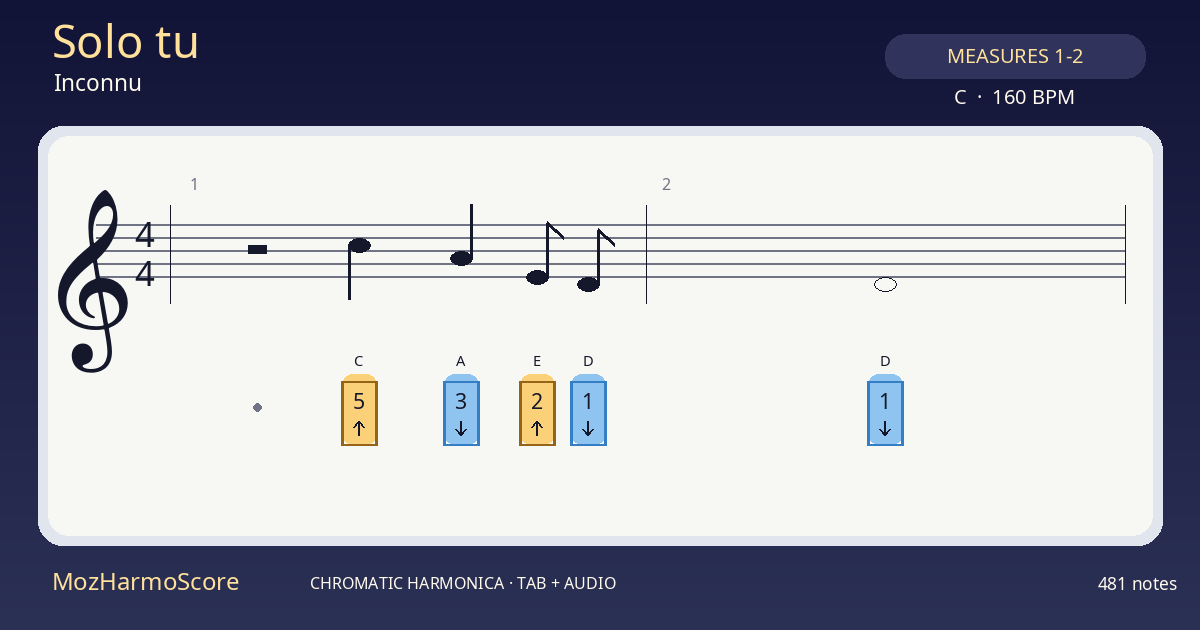
Free Solo tu harmonica notes and tab for chromatic harmonica, synchronized with audio. Key C, 160 BPM — slow it down and practise.

Pop / varietyIntermediate481 notesC160 BPM
MozHarmoScore

About this score

This imported pop line is designed to develop continuous playing on the chromatic harmonica. Its fast tempo requires methodical preparation: avoid rushing on the first read. Numerous tied notes encourage phrasing each line as a single breath, while repeated notes and register shifts call for subtle articulation. Begin by mastering repeated cells, then connect them with a steady pulse. Accuracy in altered notes should support the melody without interrupting the flow.

Presentation

Solo tu is an intermediate pop piece for chromatic harmonica that strengthens rhythmic consistency, legato playing, and register management. Its 160 bpm tempo creates continuous energy dominated by eighth notes and punctuated by rests that help organize breathing. The line spans a wide range from C4 to A5, alternating repeated motifs, tied notes, and wider leaps. Altered notes require clean chromatic button coordination without tightening the embouchure. A progressive study—first by cells, then by phrases—turns this dense writing into a fluid, expressive performance.

Why learn this piece

This intermediate piece builds rhythmic endurance and sound stability at a brisk tempo. It teaches linking long phrases while keeping altered notes clean and register changes natural. It’s an excellent step from fragmented reading to continuous pop phrasing.

Skills developed

Legato★★★★☆
Swing★★☆☆☆
Chromatic button★★☆☆☆
Rhythm★★★★☆
Speed★★★★☆
Expression★★★★☆

Music DNA

Jazz feeling35%
Expression84%
Technique100%
Breath100%
Reading100%
Improvisation35%
Rhythm99%
Chromatic button10%

AI musical analysis

Set in C major, the piece includes 20 altered notes adding color that demands precise chromatic button control. Eighth notes dominate, with many repetitions requiring a reliable internal pulse at 160 bpm. The 182 ties favor a singing style with minimal unnecessary attacks. The range from C4 to A5 and intervals up to a sixth require good instrument mapping.

Technical data

Notes481
Measures131
Tempo160 BPM
KeyC
Lowest noteC4
Highest noteA5
Max intervalsixth
Dominant rhythmeighth notes
Altered notes4%
Avg. breath7.3 notes
Fast rhythms6
Rests36
Repeated notes154
Ties182
Rangewide

Progression plan

Day 1112 BPM

Slow reading of the first two lines.

Day 2122 BPM

Stabilize breath and ties.

Goal160 BPM

Play cleanly at target tempo.

Musical goals

  • Maintain a steady stream of eighth notes at a fast tempo.
  • Execute long ties with stable breath support.
  • Coordinate altered notes precisely with the chromatic button.
  • Navigate register changes and sixth intervals smoothly.

Common mistakes

  • Speeding up repeated note groups instead of keeping pulse steady.
  • Reattacking tied notes and losing phrase continuity.
  • Pressing the chromatic button late, causing imprecise notes.
  • Forcing breath in the high register, resulting in harsh tone and fatigue.

Coach tips

  • Sing or tap the rhythm before playing: internalizing the pulse makes speed easier.
  • Practice repeated notes with minimal, regular articulation—never heavy-handed.
  • Maintain jaw and shoulder relaxation at every speed increase.

If you liked this piece

Tab analysis and practice

AI summary

At 160 bpm, this intermediate piece features mostly eighth notes, 182 ties, frequent repetitions, and a wide range from C4 to A5. Break down long phrases before aiming for the final tempo.

Suggested tempo70 -> 160 BPM

Practice goals

  • Maintain steady eighth notes without speeding up during repetitions.
  • Keep a smooth legato on long tied notes.
  • Secure transitions between low and high registers up to A5.
  • Prepare the 20 altered notes with a brief, precise chromatic button action.

Passages to isolate

  • Isolate repeated G4 series and their transitions to G#4 and A4.
  • Work on long ties on D4 and C4 while keeping steady airflow.
  • Segment register changes involving the widest intervals.
  • Practice entries after rests without attacking too strongly.

Focus points

  • Count eighth notes slowly before linking measures.
  • Plan breaths around the 36 rests and ends of ties.
  • Maintain a relaxed embouchure during repeated note returns.
  • Check altered note accuracy at reduced tempo before speeding up.

Coach

  • Distribute breath evenly over long ties: support without pushing and use silences to reset airflow.
  • Anticipate altered notes by pressing the chromatic button just before the attack and releasing quietly without rhythmic delay.
  • Practice with a metronome in groups of four eighth notes, then gradually double the length of linked segments.
  • Avoid compensating register jumps with harsh attacks, as this breaks legato and destabilizes the pulse.