Who Wants to Live Forever
Freddie Mercury
Free Who Wants to Live Forever harmonica notes and tab for chromatic harmonica, synchronized with audio. Key G, 100 BPM — slow it down and practise.
Pop / varietyEasy123 notesG100 BPM
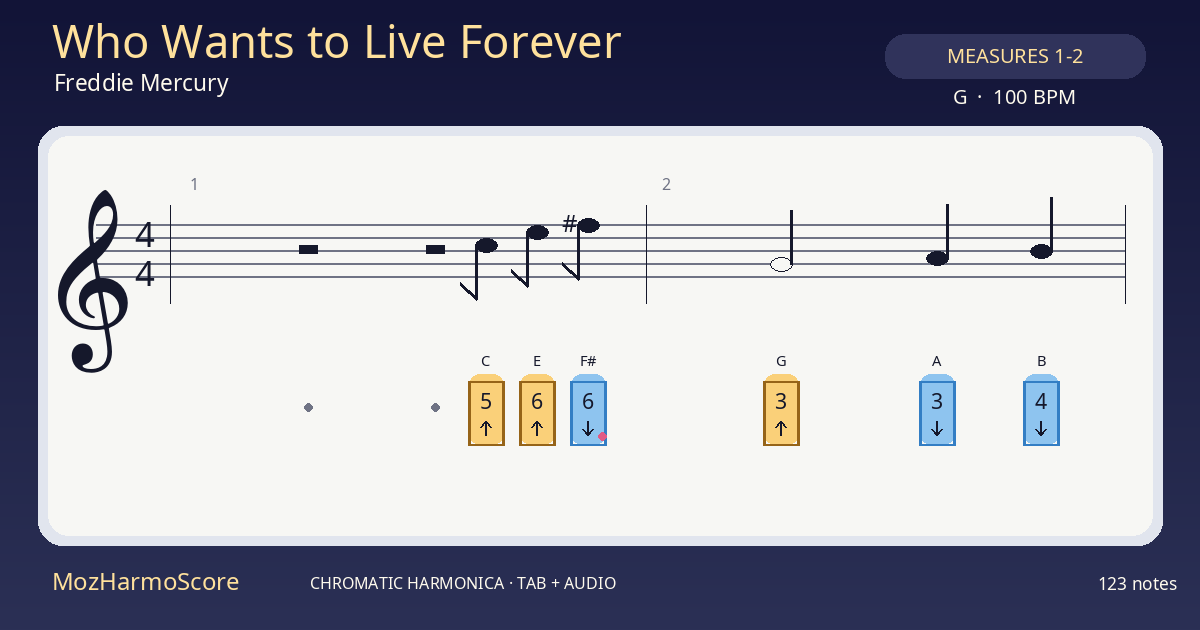
Free Who Wants to Live Forever harmonica notes and tab for chromatic harmonica, synchronized with audio. Key G, 100 BPM — slow it down and practise.
This arrangement of Who Wants to Live Forever invites a calm, singing melodic line approach. At 100 BPM, progress through short phrases rather than rushing to connect everything at once. The many rests provide natural breathing points and help maintain steady pulse. The easy level encourages a soft, even tone with smooth transitions. The few altered notes are prepared slowly and integrated seamlessly without tension in breath or movement.
Who Wants to Live Forever is an ideal pop ballad for developing a calm, expressive interpretation on chromatic harmonica. This easy-level version emphasizes breath regularity, continuous legato, and attentive listening to rests. The melody moves between low and high registers, but the moderate tempo allows careful preparation of each shift. The few altered notes require focused placement but do not add significant technical difficulty. Work in short segments, then combine them with a steady pulse and uniform tone.
This piece enhances melodic phrasing and breath control essential for ballads. Its easy level encourages methodical practice of held notes, rests, and register changes. The few altered notes provide a gentle introduction to chromatic button use in a musical context.
Set in G major at 100 BPM, the melody mainly uses eighth notes with many written breaths. The range spans from E4 to C6, requiring smooth, singing register transitions. Repeated notes and fifteen ties promote a steady legato rather than sharp articulation. Ten altered notes appear sporadically; at this easy level, they are practiced slowly and reintegrated into the melodic flow.
Slow reading of the first two lines.
Stabilize breath and legato connections.
Play cleanly at target tempo of 100 BPM.
A pop ballad in G major to practice with steady breath, connected phrasing, and special attention to the few altered notes. Use rests and held notes as anchors to keep a regular pulse.