L'isola che non c'è

Edoardo Bennato

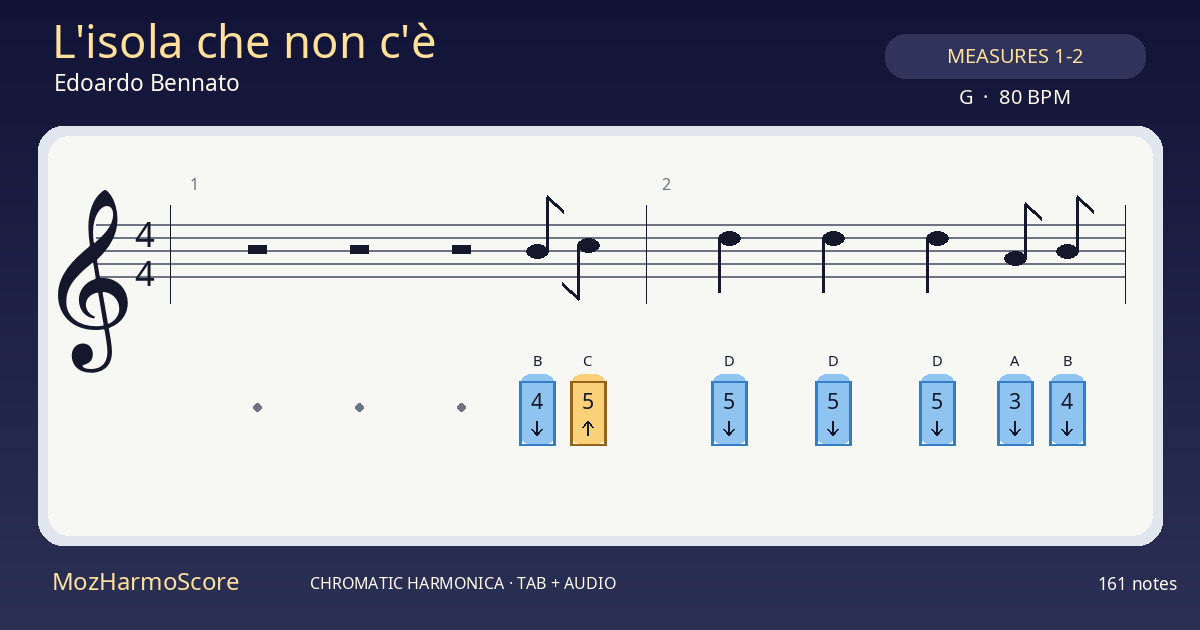
Free L'isola che non c'è harmonica notes and tab for chromatic harmonica, synchronized with audio. Key G, 80 BPM — slow it down and practise.

Pop / varietyEasy161 notesG80 BPM
MozHarmoScore

About this score

This Italian pop piece suits a gradual discovery of the chromatic harmonica. The melody stays within a medium range, featuring clearly shaped phrases and a moderate tempo that eases reading. Repeated notes help stabilize the pulse, while a few altered notes invite gentle coordination of the chromatic button. Focus on smooth articulation and prepared breathing rather than speed to highlight the song’s singing character. Rests provide valuable moments to relax the embouchure and catch your breath.

Presentation

This easy version of L'isola che non c'è offers an expressive pop melody without excessive difficulty. Its 80 BPM tempo, medium range from A4 to A5, and dominant quarter notes support comfortable reading. Rests provide natural breathing points. Some eighth notes and brief rhythms add variety, while fifteen altered notes introduce measured use of the chromatic button. The goal is to play with regularity, smoothness, and continuity, prioritizing clear tone over speed.

Why learn this piece

This piece develops steady timing, breath control, and button coordination in an accessible setting. Its melodic line also encourages singing phrasing without rushing.

Skills developed

Legato★★★☆☆
Swing★★☆☆☆
Chromatic button★★☆☆☆
Rhythm★★★★☆
Speed★★★★☆
Expression★★★★☆

Music DNA

Jazz feeling35%
Expression65%
Technique90%
Breath72%
Reading68%
Improvisation35%
Rhythm82%
Chromatic button21%

AI musical analysis

The score has 56 measures at 80 BPM, with quarter notes as the main rhythm. The melody ranges from A4 to A5 in a comfortable medium register. Twenty-two rests structure breathing, and thirty repeated notes reinforce pulse work. Fifteen altered notes require simple, regular chromatic button coordination.

Technical data

Notes161
Measures56
Tempo80 BPM
KeyG
Lowest noteA4
Highest noteA5
Max intervalsixth
Dominant rhythmquarter notes
Altered notes9%
Avg. breath5.8 notes
Fast rhythms5
Rests22
Repeated notes30
Ties0
Rangemedium

Progression plan

Day 156 BPM

Slow reading of the first two lines.

Day 266 BPM

Stabilize breath and note connections.

Goal80 BPM

Play cleanly at target tempo.

Musical goals

  • Steady reading of quarter and eighth notes.
  • Breath management between phrases.
  • Smooth chromatic button coordination.
  • Clear articulation of repeated notes.

Common mistakes

  • Rushing during eighth note groups.
  • Cutting airflow when using the button.
  • Resuming too early after rests.
  • Accenting repeated notes instead of keeping a smooth line.

Coach tips

  • Mark possible breathing spots with pencil before playing.
  • Repeat each altered passage three times slowly before integrating.
  • Keep your jaw relaxed when the melody rises to A5.
  • Record yourself at 80 BPM to check rest durations.

If you liked this piece

Tab analysis and practice

AI summary

Start at 60 BPM working in groups of two to four measures. First stabilize quarter notes, then add eighth notes and the few faster rhythms. The fifteen altered notes require a light, smooth button press without interrupting airflow.

Suggested tempo60 -> 80 BPM

Practice goals

  • Maintain a steady pulse throughout the 56 measures.
  • Play repeated notes without unintended accents.
  • Coordinate the chromatic button with continuous airflow.
  • Use rests to organize breathing effectively.

Passages to isolate

  • Isolate groups containing F# and slowly repeat pressing and releasing the button.
  • Practice the five faster rhythms separately with a metronome.
  • Prepare transitions to the higher register to avoid abrupt embouchure shifts.

Focus points

  • Keep a calm airflow during long phrases.
  • Count rests fully before resuming playing.
  • Maintain consistent pulse between quarter and eighth notes.

Coach

  • Breathe during rests and avoid fully emptying your lungs before phrase ends.
  • Press the button just before altered notes with a relaxed finger, then release cleanly.
  • Use a metronome subdividing beats in two to place eighth notes evenly.
  • Do not shorten repeated notes or press the button abruptly.